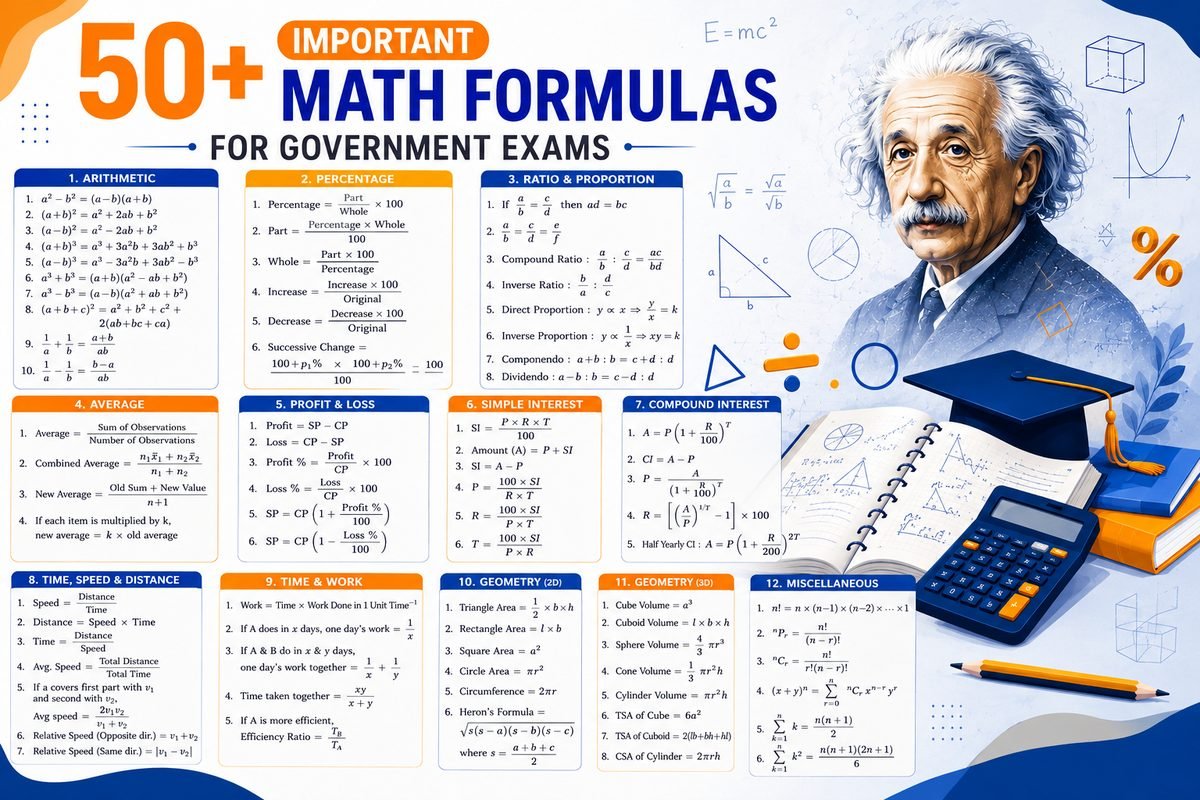
If you are preparing for ADRE, APSC, Assam Police, SSC, Railway, NEET or any other competitive exam, Quantitative Aptitude (Math) is one section where marks are won or lost purely on formula recall speed. You don't need to "solve" most questions from scratch in the exam hall you need the right formula at your fingertips.
This blog brings together the most important Math formulas from 10 high-weightage topics Number System, Percentage, Profit & Loss, Ratio & Proportion, Average & Mixture, Simple & Compound Interest, Time-Speed-Distance, Mensuration, and Data Interpretation in one place, so you can revise everything in one sitting.
Tip: Bookmark this page and revise it 2/3 times a week. Formula retention comes from repetition, not one-time reading.
Practice these formulas with free mock tests based on your class level:
Class 6 to 10 Maths Mock Tests: https://mocksky.com/exam/maths-class-6-10
Class 11 to 12 Maths Mock Tests: https://mocksky.com/exam/maths-class-11-12
1. Number System
Number System questions appear in almost every exam, especially in SSC, Railway and Assam government exams.
Divisibility Rules
Divisible By 2 — Last digit is even or 0
Divisible By 3 — Sum of digits divisible by 3
Divisible By 4 — Last two digits divisible by 4
Divisible By 5 — Last digit is 0 or 5
Divisible By 6 — Divisible by both 2 and 3
Divisible By 7 — Double the last digit, subtract from the rest; result divisible by 7
Divisible By 8 — Last three digits divisible by 8
Divisible By 9 — Sum of digits divisible by 9
Divisible By 10 — Last digit is 0
Divisible By 11 — Difference of sum of digits at odd and even places is 0 or a multiple of 11
Divisible By 12 — Divisible by both 3 and 4
Divisible By 25 — Last two digits are 00, 25, 50 or 75
LCM & HCF
LCM × HCF = Product of two numbers
HCF = (Product of numbers) ÷ LCM
Remainders
Dividend = Divisor × Quotient + Remainder
Remainder < Divisor
Indices
aᵐ × aⁿ = aᵐ⁺ⁿ
aᵐ ÷ aⁿ = aᵐ⁻ⁿ
(aᵐ)ⁿ = aᵐⁿ
a⁰ = 1 (a ≠ 0)
a⁻ⁿ = 1/aⁿ
Surds
√a × √b = √(ab)
√a ÷ √b = √(a/b)
(√a + √b)(√a − √b) = a − b
(√a + √b)² = a + b + 2√(ab)
2. Percentage
Percentage is the foundation of Profit & Loss, SI-CI, and Data Interpretation — master this first.
Percentage = (Part / Whole) × 100
Part = (Percentage × Whole) / 100
Whole = (Part × 100) / Percentage
Increase & Decrease
Increase % = (Increase / Old Value) × 100
Decrease % = (Decrease / Old Value) × 100
Successive Percentage Change
Net change % = a + b + (ab / 100) — where a and b are the two successive percentage changes (use negative values for decrease)
Percentage Points vs Percentage Change
Percentage Points = simple difference between two percentages (e.g., 15% − 10% = 5 percentage points)
Percentage Change = ((New − Old) / Old) × 100
Quick Trick: To find x% of a number, divide the number by 100 and multiply by x.
3. Profit, Loss & Discount
One of the highest-scoring topics if formulas are clear.
Profit = SP − CP | Loss = CP − SP
Profit % = (Profit / CP) × 100
Loss % = (Loss / CP) × 100
Discount = MP − SP
Discount % = (Discount / MP) × 100
MP = SP + Discount = CP + Profit
Shortcut: If Profit % = Loss % on two transactions, there is always a net loss, given by:
Loss % = (Common%)² / 100
Successive Discount Formula
Equivalent Discount % = d₁ + d₂ − (d₁ × d₂)/100
4. Ratio, Proportion & Partnership
Ratio of a to b = a : b = a/b
If a : b = c : d, then ad = bc (cross multiplication)
Partnership: A's Share : B's Share = (P₁ × T₁) : (P₂ × T₂)
Equal investment → Profit ∝ Time
Equal time → Profit ∝ Investment
Direct & Inverse Variation
Direct: y ∝ x → y₁/x₁ = y₂/x₂
Inverse: y ∝ 1/x → y₁x₁ = y₂x₂
5. Average & Mixture (Alligation)
Average = Sum of observations / Number of observations
New Average (after adding x) = (Old Sum + x) / (n+1)
New Average (after removing x) = (Old Sum − x) / (n−1)
Alligation Rule (2 ingredients)
If cheaper price = a, dearer price = b, mixture price = m:
Ratio of mixing = (b − m) : (m − a)
This single formula solves almost all mixture-based questions in under 20 seconds.
6. Simple Interest & Compound Interest
SI = (P × R × T) / 100
Amount (SI) = P + SI
CI = P [(1 + R/100)ᵀ − 1]
Amount (CI, annual) = P (1 + R/100)ⁿ
Compounding Frequency
Half-yearly: A = P(1 + R/200)^(2n)
Quarterly: A = P(1 + R/400)^(4n)
Monthly: A = P(1 + R/1200)^(12n)
Difference between CI and SI
For 2 years: D = (P × R × R) / (100 × 100)
For 3 years: D = P × R² × (300 + R) / 100³
7. Time, Speed & Distance
Speed = Distance / Time
1 km/h = 5/18 m/s | 1 m/s = 18/5 km/h
Relative Speed
Opposite directions: u + v
Same direction: |u − v|
Train Problems
Time to cross a pole = Length of Train / Speed
Time to cross a platform = (Length of Train + Length of Platform) / Speed
Boats & Streams
Downstream Speed = Boat Speed + Stream Speed
Upstream Speed = Boat Speed − Stream Speed
Speed of Boat (still water) = (Downstream + Upstream) / 2
Speed of Stream = (Downstream − Upstream) / 2
Average Speed (equal distance) = 2uv / (u + v)
8. Mensuration 2D (Area & Perimeter)
Square — Area = a² — Perimeter = 4a
Rectangle — Area = l × b — Perimeter = 2(l + b)
Triangle — Area = ½ × b × h — Perimeter = a + b + c
Parallelogram — Area = b × h — Perimeter = 2(a + b)
Rhombus — Area = ½ × d₁ × d₂ — Perimeter = 4a
Trapezium — Area = ½ × (a + b) × h — Perimeter = a + b + c + d
Circle — Area = πr² — Perimeter = 2πr
Semi-circle — Area = ½ πr² — Perimeter = πr + 2r
Important: If a square is inscribed in a circle, side = r√2 and area = 2r².
9. Data Interpretation (DI)
DI doesn't need new formulas — it tests how fast you apply Average, Percentage and Ratio.
Pie Chart Angle = (Value / Total) × 360°
Quick angle values: 25% = 90°, 50% = 180°, 75% = 270°
Sum of first n natural numbers = n(n+1)/2
Sum of first n even numbers = n(n+1)
Sum of first n odd numbers = n²
Exam Tip: In Bar/Line graphs, the difference between two values equals the difference between their bar heights or graph points — no need to calculate the actual value every time.
Frequently Asked Questions (FAQ)
Q1. Which Math topics are most important for ADRE and Assam government exams?
Percentage, Profit & Loss, Simple & Compound Interest, Ratio & Proportion, and Time-Speed-Distance are the highest-weightage topics in ADRE, APSC and Assam Police exams.
Q2. How can I remember so many formulas?
Don't memorize in isolation — solve at least 10–15 questions per topic using each formula. Formula recall becomes automatic with practice, not repetition of the formula alone.
Q3. Is this formula list enough for SSC and Railway exams too?
Yes — these are core Quantitative Aptitude formulas common across ADRE, APSC, SSC, Railway, and most other competitive exams in India.
Q4. Where can I practice questions based on these formulas?
You can attempt free topic-wise and full-length mock tests on Mocksky:
Class 6 to 10 students: https://mocksky.com/exam/maths-class-6-10
Class 11 to 12 students: https://mocksky.com/exam/maths-class-11-12
Covering ADRE, APSC, Assam Police, SSC, Railway, NEET and more, in both English and Assamese.
Final Word
Formulas only help if you can recall them under exam pressure. The best way to do that is timed practice. Once you've revised this sheet, put it to the test with topic-wise mock tests on Mocksky and track your accuracy and speed for each topic above.
Start your free mock test now:
Class 6 to 10: https://mocksky.com/exam/maths-class-6-10
Class 11 to 12: https://mocksky.com/exam/maths-class-11-12
50+ Important Maths Formulas for Competitive Exams (ADRE, SSC, NEET, Railway) – Free Cheat Sheet